
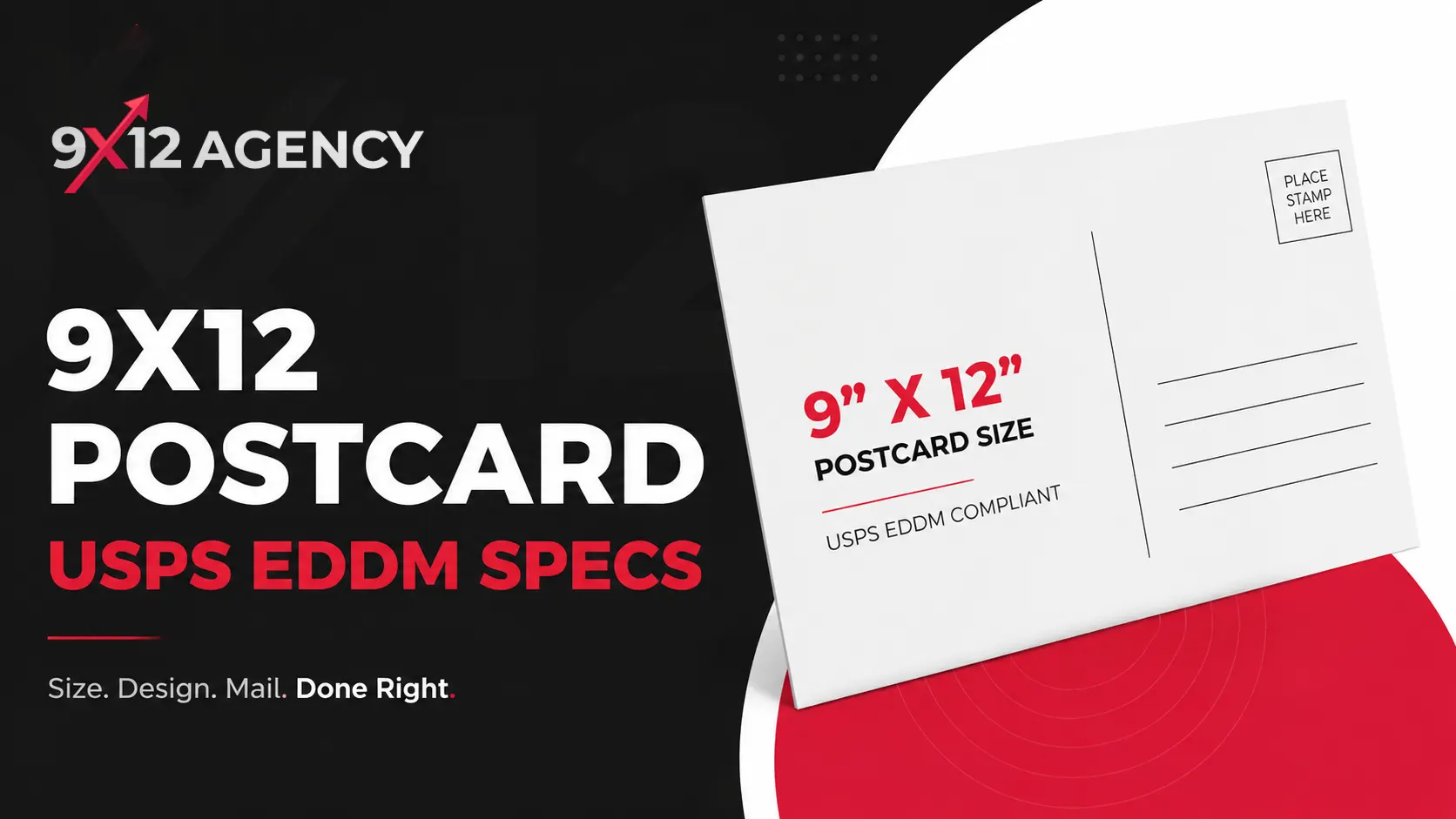
Getting the 9x12 postcard size right is the first step before you design or quote anything: you need to know the physical rules of the game — what size a 9x12 card actually is, what paper it should be printed on, and what USPS requires for it to qualify for Every Door Direct Mail (EDDM) rates. Get these right once and every future campaign reuses the same spec.
9x12 Postcard Size at a Glance
A “9x12” is a 9-inch by 12-inch card — roughly the size of a sheet of paper, but printed on thick card stock. In USPS terms it is a flat, not a postcard: it exceeds letter-size dimensions, which is exactly what makes it eligible for EDDM and impossible to miss in a stack of mail.
Common design setup:
- Trim size: 9″ × 12″
- Bleed: add 0.125″ on each side (design canvas 9.25″ × 12.25″)
- Safe zone: keep text and logos at least 0.25″ inside the trim edge
- Indicia & addressing area: reserve the standard EDDM indicia box (“PRSRT STD / ECRWSS / EDDM Retail”) in the upper right of the address side, plus the “Local Postal Customer” address block
If you’d rather not build this from scratch, our ready-made Canva templates come with the slots, bleed, and indicia area already set up — and the design and print guide walks through the full workflow.
USPS EDDM Requirements That Matter
To mail at EDDM Retail rates, your piece and process must meet USPS rules. The ones that affect 9x12 agencies:
- Flat dimensions: the piece must qualify as a flat — more than 10.5″ long or more than 6.125″ high, up to a maximum of 15″ × 12″. A 9x12 qualifies comfortably.
- Full route coverage: EDDM means every door. You mail to every address on the carrier routes you select — you can’t cherry-pick individual homes.
- Daily limit: EDDM Retail allows up to 5,000 pieces per day per 5-digit ZIP code.
- Bundling and paperwork: pieces are submitted in bundles with facing slips and the EDDM Retail form — covered step by step in our drop-off preparation guide.
- Postage: EDDM Retail runs about 24 cents per piece; rates adjust periodically, so confirm the current price on USPS.com before quoting a campaign.
Choosing Paper Stock
The card is your product — it has to feel substantial. Typical choices from best to budget:
- 14pt–16pt card stock, gloss or matte: the standard for 9x12 co-op cards; rigid, premium feel, holds color well
- 100lb cover: a solid mid-range option, slightly thinner than 14pt
- 100lb gloss text: bends easily — generally too flimsy for a card carrying 20+ paying advertisers; avoid it if you can
Coating matters too: UV (high gloss) makes colors pop; matte or satin reads more upscale and is easier to write on — relevant if you include a coupon customers bring in.
Route Selection Basics
Carrier routes typically contain a few hundred addresses each. Using the free USPS EDDM mapping tool you can filter routes by residential count and median household income — stack routes until you hit your target quantity (5,000 homes is the common starting point for a first campaign). Higher-income routes support higher spot pricing.
One Spec Sheet, Every Campaign
Lock your spec once — 9″ × 12″ trim, 0.125″ bleed, 14pt stock, EDDM indicia — and every future card is a copy-paste job. That’s also why templates pay for themselves: the agency starter bundle includes print-ready layouts in multiple spot configurations, and the 9x12 Agency CRM exports print-ready PDFs with the slots already positioned.
Next read: how many ad spots fit on a 9x12 mailer
→ Set your card size, layouts and spot prices in 9x12 CRM — free to start.
