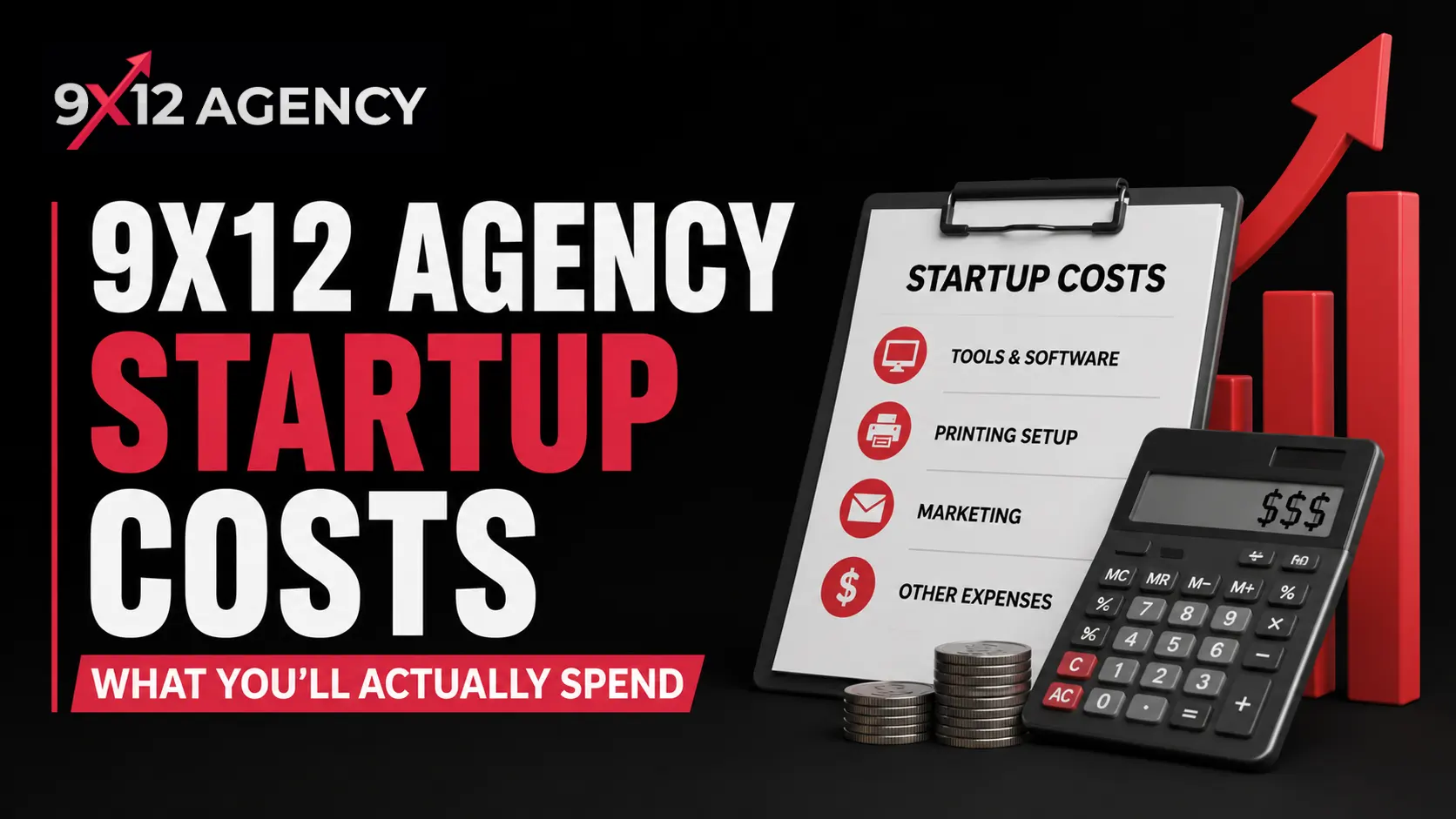
Understanding 9x12 agency startup costs is the first step for most first-time business owners: the startup costs are genuinely low, andm the biggest expenses only happen after you’ve collected money from advertisers. Here’s a realistic budget — what’s essential, what’s optional, and what you can skip entirely at the start.
The Big Insight: Your Major Costs Are Pre-Funded
Print and postage are by far the largest numbers in this business — roughly $2,700–$3,700 for a 5,000-home campaign. But in the shared-cost model you sell the ad spots first and print after. Advertisers fund the campaign; you never front the big costs from savings. What you actually need to launch is the small stuff below.
Essential 9x12 Agency Startup Costs
1. Business registration: $0–$150
Many owners start as a sole proprietor with a DBA (often under $50 depending on your county) and upgrade to an LLC later. Requirements vary by state — see how to legally start an EDDM agency for the full walkthrough.
2. Design tools and templates: $0–$100
Canva’s free tier is enough to edit a professional template. Rather than designing a 24-spot grid from scratch, start from a pre-built 9x12 template with slots, bleed, and the USPS indicia already placed — or grab the starter bundle, which adds 50+ industry ad designs and an agency website template.
3. A way to take payments: ~3% per transaction
Stripe or Square cost nothing up front — you pay standard card processing fees (roughly 3%) only when an advertiser pays you. Collecting payment at booking, not after, is the discipline that makes the pre-funded model work.
4. Proof-of-concept marketing: $0–$100
Your first advertisers come from walking into businesses, local Facebook groups, and referrals — effectively free. A small budget for sample card prints to show prospects is worth every dollar.
Optional (But High-Leverage) Costs
Software: $0 to start, $59/mo when you’re ready
You can run campaign #1 on spreadsheets and invoices. The chaos starts around campaign #2 — tracking which spots are taken, who’s paid, whose ad file is missing. The 9x12 Agency CRM has a 14-day free trial (no credit card) and replaces the $200–$400/mo you’d otherwise assemble from separate booking, CRM, email, website, and invoicing tools. Start the trial when you start selling spots, not before.
A domain for your agency: $10–$15/yr
A branded booking link closes deals faster than a phone-tag process. The CRM includes a free subdomain and hosting; a custom domain makes it fully yours.
What You Do NOT Need to Start
- An office — this is a from-home business
- Employees — solo is the standard starting point
- Inventory — nothing is printed until the card is funded
- Paid ads — door-to-door and local groups outperform them early on
- A custom-coded website — a template or the built-in site builder is plenty
Two Sample Launch Budgets
Lean launch (under $200): DBA ($50) + Canva free + a 9x12 template ($13–$20) + sample prints ($50) + free CRM trial. Everything else waits until advertisers have paid.
Comfortable launch (about $500): LLC filing + the starter bundle + domain + sample prints + first month of Pro software. You look established from day one.
Either way, the model’s economics do the heavy lifting: one filled card can return your entire startup budget several times over. Start with the free course, pick your first neighborhood, and let the advertisers fund the rest.
How to Start a 9x12 Postcard Marketing Agency ($3,900/Mo Model Explained)
Next read: what to charge advertisers on a 9x12 postcard · how many ad spots fit on a 9x12 mailer
→ Keep startup costs low: 9x12 CRM is free to start, with booking pages and payments built in.
