
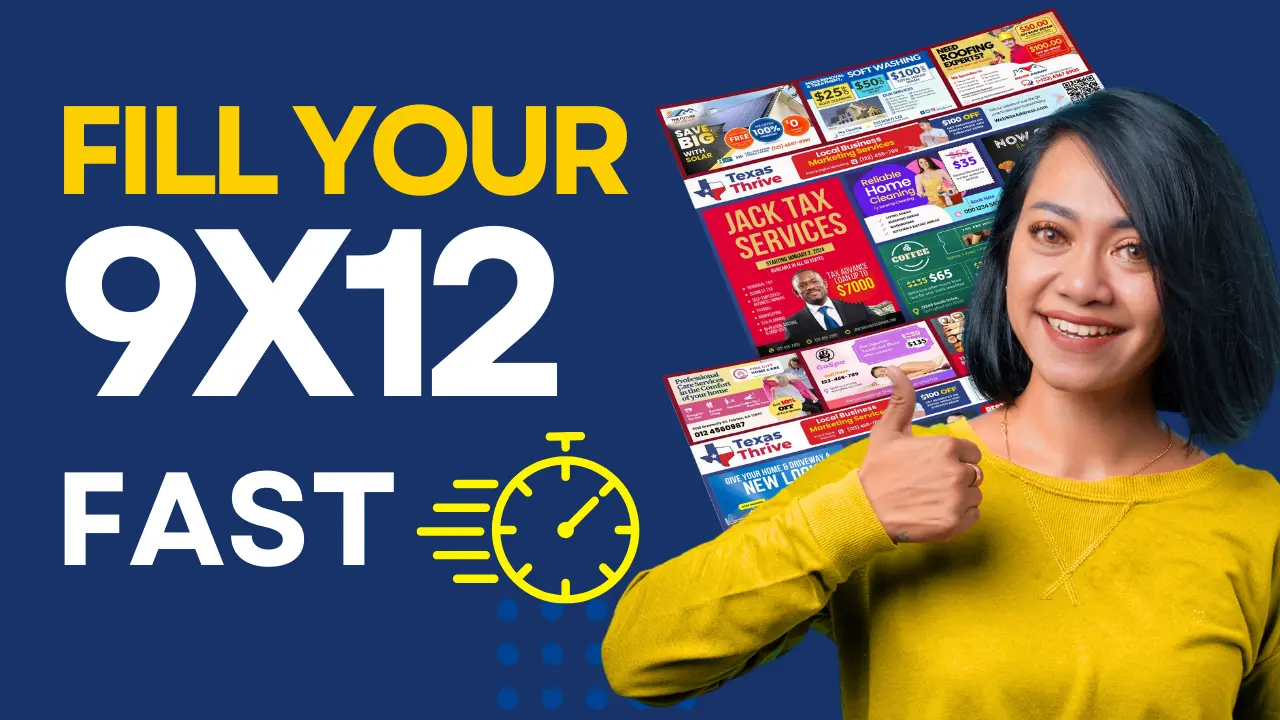
The complete guide to finding local businesses, making your pitch, and closing with confidence, even if you’ve never sold anything before
You can have the best postcard design, the best neighborhood, and the best pricing in your market. None of it matters if you can’t fill the card.
Selling ad spots is the core skill of a 9x12 agency owner. And the good news is, it’s not traditional sales. You’re not convincing anyone to try something new. You’re offering local businesses a proven, tangible way to reach thousands of homes in their own neighborhood. Most of them already understand direct mail. Your job is to put the right offer in front of the right businesses at the right time.
This lesson covers exactly how to do that.
Before You Reach Out: Know What You’re Selling
Before you contact a single business, get clear on your offer. You should be able to explain it in two sentences:
“I run a shared-cost postcard that mails to [X,000] homes in [neighborhood]. One business per category, so your competitor can’t be on the same card.”
That’s your pitch. Everything else is details.
The exclusivity angle is important. Business owners don’t want to share a card with their direct competitor. Leading with “one business per category” immediately creates a sense of scarcity and value, without you having to hard sell anything.
The Businesses Most Likely to Say Yes
Not every local business is a good fit for direct mail. You want businesses that:
- Serve residential customers (homeowners, families, renters)
- Have a high average transaction value ($200+)
- Rely on local reputation and repeat customers
- Are actively looking for new clients
Best categories to target first:
- Roofers and contractors
- HVAC and plumbing companies
- Dentists and dental offices
- Landscaping and lawn care
- Real estate agents
- Pressure washers
- Junk removal
- House cleaning services
- Pest control
- Chiropractors and physical therapists
- Auto detailing
- Insurance agents
Avoid for your first campaign:
- Restaurants with low margins
- Retail shops dependent on foot traffic
- Businesses that serve a very narrow niche
- National chains with centralized marketing decisions
Start with service businesses. They have the budgets, they serve homeowners directly, and they’re used to spending on local marketing.
4 Ways to Find Businesses to Contact
1. Google Maps
This is the fastest way to build a prospect list for any neighborhood.
Open Google Maps and search by category and location:
- “roofer near [postal code]”
- “dentist in [city name]”
- “lawn care [neighborhood]”
For each result, note the business name, phone number, website, and whether they have reviews (businesses with active reviews are more engaged with marketing). Build a simple spreadsheet with 30–50 names before you start reaching out.
What to look for: businesses with 10–50 Google reviews, a real website, and a service area that overlaps with your mailing route. These are active businesses investing in their reputation, ideal candidates.
2. Facebook Groups and Business Pages
Search Facebook for local business groups in your area:
- “[City] Small Business Owners”
- “[Neighborhood] Community Board”
- “Local Service Pros in [Area]”
Look for business owners who are active in these groups, commenting, posting about their services, or running local ads. Send a short, friendly direct message. Don’t pitch immediately. Start with a genuine question or compliment, then introduce your offer naturally.
3. Drive the Neighborhood
If you’re targeting a specific postal code or neighbourhood, drive it. Note every service business with a van, truck, or yard sign. These are active local operators, exactly your audience.
Take photos of their signage to record their business name and number. You’ll find businesses this way that don’t show up in Google searches.
4. Your Own Network
Don’t overlook who you already know. Local business owners you’ve hired, family connections, businesses you frequent, these are warm conversations, not cold outreach. Start here before going cold. A warm “yes” from someone who trusts you is worth ten cold calls.
How to Reach Out: Scripts That Work
Email Outreach
Subject line: Promote your business to [X,000] homes in [Neighborhood], one spot left
Body:
Hi [First Name],
I’m putting together a shared postcard campaign mailing to [X,000] homes in [Neighborhood] this [month].
Each business gets its own ad spot, and we only allow one business per category, so there’s no competition on the card.
I have a [category] spot still available and thought of you. Would you like to see a sample and pricing?
[Your Name] [Your Business Name] [Phone / Booking Link]
Keep it short. The goal of the email is not to close, it’s to start a conversation.
Phone / Text Follow-Up
If you don’t hear back in 2–3 days, follow up by phone or text:
“Hi [Name], this is [Your Name] — I sent you an email about a local postcard campaign in [Neighborhood]. Just wanted to make sure it didn’t get buried. Do you have 2 minutes to hear about it?”
Most closes happen on the second or third touchpoint. Don’t give up after one email.
In-Person Pitch
For local businesses, showing up in person with a printed sample postcard is still one of the most effective approaches. Walk in, ask for the owner or manager, and say:
“Hi, I run a local shared postcard that goes to [X,000] homes in this area. I wanted to show you a sample and see if you’d be interested in a spot. It takes two minutes.”
Have a printed sample in hand. A physical postcard is more convincing than any email or phone call.
Handling the Most Common Objections
“I’ve tried direct mail before and it didn’t work.”
“That’s actually pretty common with solo mailers, they’re expensive and easy to ignore. With a shared card, you’re reaching more homes at a fraction of the cost, and the format gets noticed because it’s large and local. Would you want to see the sample so you can compare?”
“What kind of results will I get?”
“I can’t guarantee specific results, no one honestly can. What I can tell you is that businesses in [category] consistently get calls from mailers in this area because homeowners are actively looking for services like yours. A lot of our advertisers track their results with a unique phone number or QR code, and many rebook every campaign.”
“I don’t have a design ready.”
“That’s not a problem at all. If you’re using our booking platform, you can choose from a library of professionally designed ad templates for your industry and customize it yourself in Canva — no designer needed. Or I can handle the design for you for a small fee.”
“Your price is too high.”
“I understand. The price covers your share of printing and postage for [X,000] homes — it works out to less than [X cents] per household. For a home service business, one new customer from this campaign typically covers the cost of the entire ad. Does that help put it in perspective?”
“Let me think about it.”
“Of course, take your time. Just so you know, I only have [X] spots left on this campaign and once the [category] spot is taken I can’t add another in your industry. When would be a good time to follow up?”
Closing the Sale and Collecting Payment
Once a business says yes, move fast. The longer the gap between “yes” and payment, the higher the chance they back out.
Send a booking link immediately. If you’re using the 9x12 Agency CRM, you can send clients directly to your booking page where they select their spot, pay online, and confirm their details, all in one flow. No invoices to chase. No “I’ll pay you next week.”
If you’re collecting offline, take cash or a check on the spot, or send a Stripe payment link via text the same day.
Once payment is collected:
- Send a confirmation with campaign details and mail date
- Ask for their ad design or direct them to the Canva template library
- Add them to your campaign tracker
The moment payment is collected, they’re locked in. That’s the 9x12 model working as designed.
How Many Businesses Do You Need?
A standard 9x12 campaign has 8–16 ad spots depending on your layout. Here’s a realistic closing rate breakdown for new agency owners:
| Contacts | Expected Response | Expected Close |
|---|---|---|
| 50 businesses contacted | 15–20 respond | 8–12 close |
| 75 businesses contacted | 20–30 respond | 12–16 close |
These numbers improve significantly as you get more comfortable with the pitch and build a reputation in your market. By your third campaign, you’ll have repeat clients filling spots before you even start outreach.
The Professional Way to Manage Bookings
Manually managing 12 clients across emails, texts, and spreadsheets is how most agency owners start, and how most stay stuck.
The 9x12 Agency CRM was built to replace that chaos. Instead of chasing clients for payment and designs, you send them to your booking page. They pick their spot, pay, and select their ad template. You see it all in one dashboard.
When a spot is filled, it’s gone. When a campaign is full, it closes. No double-bookings, no confusion, no manual tracking.
→ See how 9x12 CRM works
Ready for the Next Step?
You’ve got your prospect list, your pitch, and your closing scripts. Now it’s time to put the campaign together, designing the layout, collecting ad files, and getting the postcard ready for print.
→ Continue to Lesson 4: How to Design and Print Your Co-Op EDDM Mailer
Need ready-made tools to look professional from day one? Our Agency Starter Bundle includes Canva postcard templates, 50+ industry ad designs, and a ready-to-launch website. Or run your agency on a full platform: 9x12 CRM
How to Find & Close Advertisers for 9x12 Postcards (3 Proven Methods)
Next read: how many ad spots fit on a 9x12 mailer
