
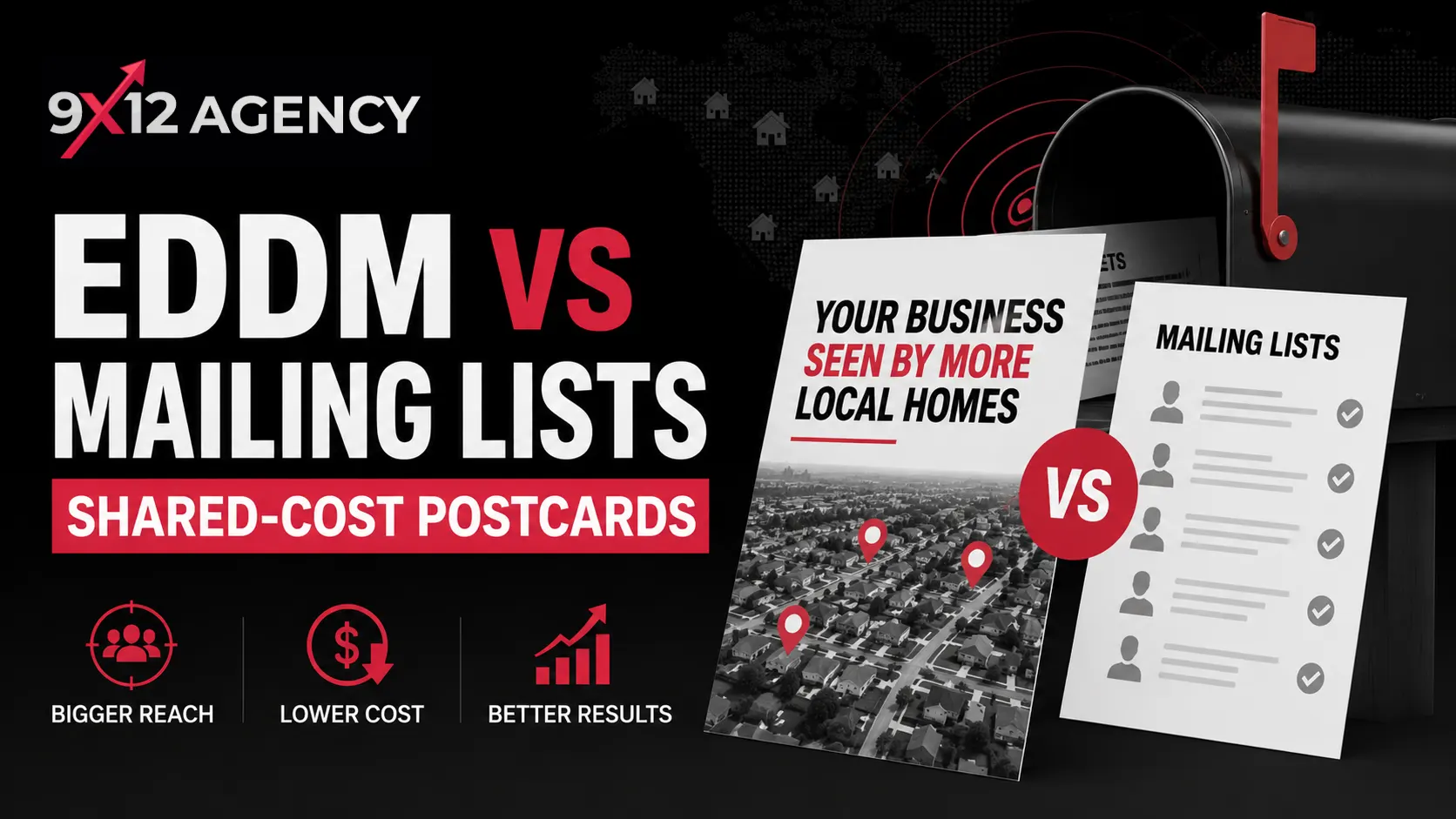
When you’re weighing EDDM vs Mailing Lists for your shared-cost postcard business, there are two ways to get a 9x12 card into mailboxes: EDDM (Every Door Direct Mail), where you saturate entire carrier routes, or addressed mail using a purchased mailing list. For shared-cost co-op cards, one of these is almost always the right answer, but it’s worth understanding both.
How Each Works
EDDM: every door on the route
You pick carrier routes on the USPS mapping tool and your card goes to every address on them — no names, no list, no mailing permit required at the retail level. Postage runs about 24 cents per piece (verify current rates on USPS.com), and you deliver bundled cards to the local post office yourself — the process we cover in preparing EDDM mailers for drop-off.
Mailing lists: addressed mail to selected households
You buy or build a list (by demographics, homeownership, income, new movers, etc.), address each piece, and mail at First-Class or Marketing Mail rates. This typically requires a mailing permit or a mail house, plus the cost of the list itself — and postage per piece is meaningfully higher than EDDM saturation rates.
EDDM vs Mailing Lists: The Comparison That Matters for Co-Op Cards
- Cost per piece: EDDM wins clearly. Saturation postage + no list cost + no addressing keeps your per-piece cost at roughly half of addressed mail.
- Targeting: Lists win on precision (specific households), EDDM targets at the neighborhood level (income, homeowner density by route). For a card selling pizza, HVAC, and dentistry to a whole neighborhood, route-level targeting is exactly the right granularity.
- Simplicity: EDDM wins. No permit, no list hygiene, no addressing step — important when you’re running campaigns solo.
- The advertiser pitch: “Your ad reaches all 5,000 homes in this neighborhood” is concrete and sellable. A filtered list is harder to explain and audit.
Why Shared-Cost Cards Are Built for EDDM
The co-op model works because many local advertisers share the cost of blanketing a neighborhood they all serve. Their customer bases overlap geographically — the plumber, the pizzeria, and the gym all want the same 5,000 households. Saturation is the product. That’s why the 9x12 model and EDDM flat specs fit together so naturally, and why the numbers in our pricing guide assume EDDM postage.
When a Mailing List Actually Makes Sense
Addressed mail earns its higher cost when a single advertiser needs precision EDDM can’t offer:
- New-mover campaigns — welcome offers for people who just bought homes
- High-ticket niches — a roofer targeting only homes over a certain age or value
- Customer reactivation — mailing an advertiser’s own lapsed customer list
These make great premium add-on services once your agency is established — but they’re single-advertiser products, not co-op cards.
The Bottom Line
For your 9x12 shared-cost card: use EDDM. It’s cheaper per piece, simpler to execute, and matches how the product is sold. Save addressed lists for future upsells. If you’re still mapping out the business itself, start with the free course — and when you’re ready to run campaigns, the 9x12 Agency CRM tracks every route, advertiser, and payment in one dashboard.
Next read: 9x12 agency startup costs
→ Plan routes, sell spots and take payments in 9x12 CRM — free to start.
